Posts mit dem Label Excursion werden angezeigt. Alle Posts anzeigen

Freitag, 1. September 2017

Excursion: Visit to Croatia – Restaurant tips for Zagreb, Zadar and Split

My wife and I just came back from a summer vacation in Croatia. The country is famous mostly for its long Adriatic coast line with many small islands scatter just short ferry trips away. In general, it is not advisable to travel Croatia in August as this is high season and touristy places, especially on the coast, get extremely crowded. Unfortunately, work does not permit us to take holidays later, so it was either now or not this year. We anyway had a good time, trying to ignore the tourist crowds, and instead discovering the culinary offerings.
Croatia is culturally and culinarily part of the distinct Western Balkan region and thus very close to Bosnia and Serbia despite remaining grievances between the nationalities after the collapse of Yugoslavia and the ensuing war. These countries not only share a common language, but many dishes and food costumes. Most notably, as in the entire region, ćevapčići is a popular street food. This is sausage shaped meat consisting of ground beef, pork and lamb mixed with eggs and spices. The Bosnian/Muslim version would be without pork and so every area of the Balkan has their own variety of the dish. It is a regional specialty that derives from the Ottoman rule of the region. Cevapčići is close to the kebab of Turkey and is usually served, just like the popular döner kebab version, in a flatbread. 
Croatia is also strongly influenced by Italy. Not only did the Romans leave cultural and architectural traces, but also the Venetian kingdom controlled most islands and cities of the Dalmatian coast during the Renaissance era. Culinarily, Croatia is thus also part of the typical Mediterranean food culture with its focus on fresh vegetables, olive oil and wine production. The country is indeed a proud wine producer and it is here, where Eastern European beer culture meets Southern wine culture. Croatia is famous for the Zinfandel grape, which originates there and is grown in large parts of the former Austrian-Hungarian empire. Now it is a major grape grown in the Californian Napa Valley. The Croatian name for it is Crljenak Kaštelanski, rather complicated for foreign tongues. I can recommend however a cross bread of the Zinfandel that I became enthusiastic with during the trip called Plavac Mali.
We ate very well in Croatia and I give you here a few highlights, which can be taken as recommendations for your future visit. Coming from Germany, we first arrived in sunny, or better scorching hot, Zagreb, the capital in central Croatia. During our first night out in the city, we had dinner at Vinodol (link), which is a rather upscale, but popular restaurant with plenty of space. I very much enjoyed that they had a half-open terrace where smoking was prohibited. We shared one dish of lamb with potatoes and cabbage, because we also wanted to try the cheese platter. I liked the lamb, but the cheese was the absolute highlight. One of the best platters I ever had – nicely decorated and great strong cheeses. We also enjoyed our first bottle of Plavac Mali there.


A second great food place in Zagreb was Batak grill (link), which was heavily advertised in the city but indeed did not disappoint the promises. We had some great ćevapčići with the traditional ajvar dip. My wife was also enthusiastic about the Balkan-typical Šopska salad, which is very simple – just tomatoes, cucumbers, onion, oil and feta cheese - but with fresh ingredients this is really tasty. After exploring the capital a bit, we had a long bus journey coming that took us to the coastal region.
The first stop on the Adriatic coast was Zadar, which is a small Venetian-style town on a charming peninsula. It is most famous for its sea organ, where the water tides flood into an architectural design that creates sounds. This was pretty cool, but our food was also amazing, which is why I enjoyed the place very much. At the coast, there is of course very good seafood. I like especially fish very much and so I tried a nicely grilled sea bass in a restaurant called 2Ribara (link). The fish was fresh and came with an excellent swiss chard on the side. Secondly, we had a wonderful evening at Harbor Cookhouse & Club (link), which is a fine dining barbecue located on the water front of the harbor. It is more on the pricey side for Croatia, but very much worth it. I had a tuna steak done to perfection with some spicy wasabi. Of course, the bottle of Plavac Mali was fantastic as well.


After another long bus ride, where at least one could enjoy the fimpressive landscape of the Dalmatian coast, we finally arrived in Split. The city is incredibly touristy, but we nonetheless found some great restaurants. For both dinners, we visited something called a konoba, which just means shop/diner in Croatian, but hear specifically means seafood diner. Both places were located near each other in something of a small restaurant area. Despite many tourists in these places, the flair was great, the service friendly and food fantastic. The first one was Konoba Matejuska (link), where I had calamari with swiss chard on the side – and a great bottle of Plavac Mali. The second place was Konoba Varos (link), where I wished I was hungrier. They had really great seafood on the menu. I enjoyed an excellent seafood risotto with scampi and mussels – and we had of course a great Plavac.
To sum up, my advices are 1) don’t go in August and avoid the tourist crowds 2) eat ćevapčići for fast food lunch and seafood for dinner especially at the coast 3) dink Plavac Mali wherever and whenever possible.

Sonntag, 28. Mai 2017

Excursion: Visit to Lyon – impression on the capital of gastronomy

As this blog makes no secret about, I am big fan of good food. Then, what is not a better idea if not for me to visit a city that is nicknamed the capital of gastronomy. It also seems a no-brainer that this capital should be in France, so world-renowned for its hearty cuisine and the cradle of haute-cuisine with its star chefs. My wife and I, decided to visit Lyon, which is not only a major economic center of France, but also deemed to be epicenter of French cooking. Charmingly located on the confluence of the Rhône and Saône rivers, its cuisine resembles everything so dearly celebrated about French food. The city is wedged in between two major wine regions producing high quality, usually softer wine: the Beaujolais in the north and the Côtes du Rhône to the south. It is also close to the Alpes and the Massif Central-Auvergne, which are major cheese producing regions. Finally, the city is known for its hearty meat-based cuisine, born out of catering to the hard-working silk laborers of old Lyon, using every part of the beasts possible – from pig’s feet to goose’s livers.


We spent a long weekend in Lyon expecting to mostly eat well and drink plenty. Our first stop was therefore straight to famous food market of Les Halles de Lyon-Paul Bocuse (link). This is an assembly of fromageries, charcuteries, fish and vegetables shops selling high quality produce and small restaurants that already processed the ingredients for you. The facility was initiated by Paul Bocuse, who is something like a local culinary god. The chef world-wide renowned for its inventive cooking style was born in Lyon metropole and operates a three-star restaurant in the city since decades. The local Frenchmen and tourists can get a great impression of the riches our earth is producing and humans forming into products for our enjoyment – endless amounts of different cheeses, fresh seafood, ham and salamis in various variants to colorful macarons, biscuits and tarts. Obviously, we did not get around trying some of those great products. We had some amazing macarons – almost expected to be that fantastic in France – and sat down to enjoy a cheese plater. One of the local cheeses I enjoyed the most is the Bleu d’Auvergne, which is a very strong blue cheese and went extremely well with the softer Côtes du Rhône red wine we ordered. We were off to an excellent start.


For dinner, I reserved in a traditional bouchon – another must do when going to Lyon. Bouchons are local restaurants serving traditional Lyonnaise food typically in a homey atmosphere. Bouchons are scatter around the city, but especially the Old Town (Vieux Lyon) is absolutely packed with them. Unfortunately, it is quite difficult to find an actual authentic bouchon there. I guess only the locals know which one is really great. Anyway, I studied a bit and think found one that is quite alright – though I don’t know how authentic. We went to Les Fines Gueules (link) and it was quite as expected – situated in an old charming house, the interior decorated in red and occasionally the typical red-white-squared patterns showed up. We were greeted very friendly and, contrary to some stereotypes (and actual experiences), received great service. All bouchons usually offer menus of three courses: an entrée, a main plat and a dessert/cheese. My wife went for a poached egg in creamy red wine sauce. I ordered escargôts (snails) as entrée. I know they come (or are more famous) from Burgundy, but since I tried them already sometime before, I decided to wanting them again. It sounds more adventurous than it is. The texture is fish-like and the taste dominated by the butter that the snails are cooked in. As a main course, my wife had the veal and I took the pike dish. My fish was so processed that I could hardly identify what was done to it, but I quite like it. The sauce was of course also heavy and delicious. Finally, I got a classic crème brulée as dessert. The mandatory red wine also paired well with everything. Overall, I do not know how authentic this experience really was, but I enjoyed it anyway.


Lyon, of course, boosts plenty of different restaurants. But I found it surprisingly difficult to find really great places just by roaming around the city. I guess, my expectations were too high, also it doesn’t help not to speak French and only visiting for short-time without the help and knowledge of a local. The bouchons are really hard to tell apart, I found. They look very similar, and especially the Old Town is so overloaded with them that whole squares and streets had basically no house not having a bouchon restaurant. I also found it bewildering that most food place close the kitchen after 2pm and only open around 6-7 pm again. This is of course appropriate for a working day, but makes it difficult for a foody tourist expecting to eat all the time anywhere.
Nonetheless, I had one more fantastic food experience on the last day. We went to a nice trendy restaurant called Le Potager des Halles (link), where we were lucky to be early and secure a table. The weather was still very warm and so we could very well sit outside. The place was extremely popular and the terrace filled quickly. I felt lucky to enjoy the big city flair on a charming street with majestic house facades framing the scenery. As usual, I tried to order in French, not understanding really the menu. I ended up getting a carpaccio-style dish of raw beef. It was not what I thought I will have, but it turned out to be absolutely amazing. It was very soft and flavorfully dressed. We too had a cheese platter and some red wine of course. Again, the cheese was to die for and it was a fantastic end to our culinary short-trip to the Rhône-Alpes region.


Sonntag, 2. April 2017

Excursion: Visit to Monterrey – impression on northern Mexican food

This blog post has a special topic on my recent holiday visit to the northern Mexican city of Monterrey. Coming back from a two-week-long stay, I want to make a small topical excursion and summarize my impressions on the cuisine of northern Mexico. Monterrey is a large industrial center situated at the northern fringes of the massive Sierra Madre Oriental mountain range that stretches from the center of Mexico towards the US-Mexican border in the north. The large mountains with their distinct peaks dominate the city-scape and gave Monterrey its name as the king of mountains. A couple of hours away from the Texas border, the city is one of Mexico’s main business centers and the country’s second or third largest urban area (competing with Guadalajara).


The cuisine in Monterrey can be characterized as northern Mexican, with its main feature of being heavily beef based, and is very much distinct from central Mexican (more pork) and southern/coastal Mexican (fish and tropical fruits). Northern Mexican food relies on its cattle farming surrounding producing high quality beef and having a strong ranch tradition among others leading to the output of a variety of cheeses. On the other hand, the cuisine uses ingredients that are typical for the whole country’s food, especially tomatoes, avocadoes, beans, chili and habanero based salsas and corn and wheat tortillas.
During my stay in Monterrey, I visited a couple of restaurants and I picked out a few examples in order to give a quick overview of the regional food. One of our first visits was for breakfast at Lázaro y Diego (link). It can be taken as a typical Mexican breakfast, very heavy and filling for a European stomach. I had bacon and sausages covered with cheese and topped with fried tortilla pieces and mashed beans on the side. My wife ordered chilaquiles, which is fried corn tortillas soaked in red and green sauce, topped with chicken, cream and cheese. The typical Mexican breakfast is rich and of intense flavor. Unlike European breakfasts, it is not sweet, but rather resembles a lunch and can be even intensified with spicy salsas.


Now to the most comprehensive symbol of Mexican cuisine: the taco. They are eaten at any time, from a quick lunch snack to a proper dinner, and come with a wide range of fillings, from beef cuts (e.g. arrachera), to pork (e.g. cochinita) and to shrimps (camarón). Mixed in are different side ingredients with imagination being the limit. Spicy salsas can be typically added as one prefers. Everything is wrapped in either a wheat or corn tortilla. There are all kind of places where one can get them: taco stands on the street, in fast food chains, in fine dining restaurants. We went to a fantastic place called Chuchito Perez (link). We had the most memorable set of tacos of my trip. My shrimp stuffed version was delicious, very juicy and refreshing. I usually go for the corn tortilla since I love the taste of it and they are hard to get in Europe.


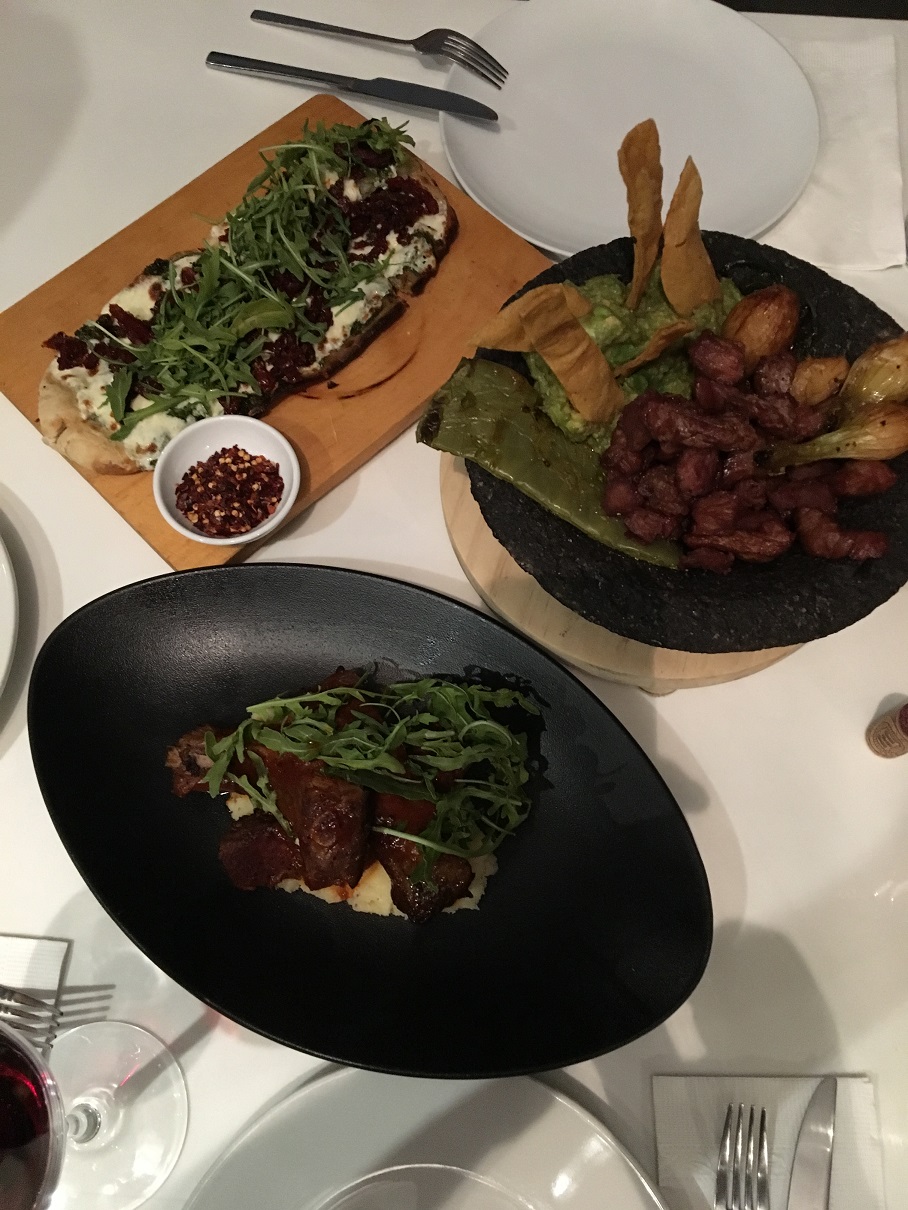
Another day, we went to a restaurant on the deck of a former steel foundry called El Lingote (link). The retired steel mill stands in the center of a now redeveloped industrial park in the heart of Monterrey and is symbolic for the past and present industrial character of the city. The restaurant boosted good food and great service. We ordered a few dishes to share. Among them was a Monterrey classic: chicharrón de ribeye. This is fried beef cuts and usually comes with guacamole. The name ribeye already indicates that usually the nice part of the cow is used and therefore this dish is extremely delicious. Together with guacamole, it is very nurturing food and indeed filled my stomach up quite completely, even though it is typically serves as an ‘entrée’.


Finally, we also visited other restaurants where the highlight was also a ribeye. Beef (and also the related BBQ culture) is central to northern Mexican food culture. One place was El Diego (link), which is actually an Argentinian restaurant. Indeed, beef is loved so much that even finest beef is imported from south America even though cattle farms are all around the neighboring regions of Monterrey. My ribeye steak was very juicy and just plain delicious. Another occasion was a visit to Mercurio (link), a fine dining restaurant in the upper-class neighborhood of San Pedro. We had a 1200g ribeye cut with bone, which we shared. The crust was nicely salty and the meat very tender. Overall, I loaded up so much beef during my holidays in Mexico that I had enough for the rest of the year. My highlights of northern Mexican food: delicious (corn) tacos and beef with a price-quality ratio nowhere to be found in Europe.